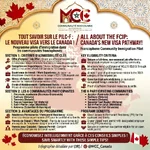
The Francophone Community Immigration Pilot (FCIP / PILC-F) is a regional immigration pathway established by Immigration, Refugees and Citizenship Canada (IRCC) to address labor shortages and support the demographic growth of Francophone communities outside Quebec.
Key Eligibility Criteria
- Job Offer: You must secure a full-time, non-seasonal job offer from a designated employer located in one of the participating communities.
- Language Skills: A minimum French language proficiency of NCLC 5 (Canadian Language Benchmark / CLB) across all four skills (speaking, writing, reading, listening) through an official test (TEF Canada or TCF Canada).
- Work Experience: At least 1 year of paid work experience (within the last 3 years) related to the TEER category of the targeted job. (Exemptions exist for recent graduates from post-secondary institutions within the community).
- Education Level: A Canadian high school diploma or an equivalent recognized foreign credential (ECA).
- Settlement Funds: Proof of sufficient financial resources to settle, unless you are already legally working in Canada.
- Acadian Peninsula (New Brunswick)
- Sudbury (Ontario)
- Timmins (Ontario)
- Superior East Region (Ontario)
- Saint-Pierre-Jolys (Manitoba)
- Kelowna (British Columbia)
- Direct access to Permanent Residency (PR) for the applicant and their family.
- Transitional Work Permit: Option to obtain a 2-year closed work permit with the designated employer while the PR application is processed.
- Spouse Work Permit: The spouse or common-law partner is eligible for an open work permit to work within the same community.
Le Programme pilote d’immigration dans les communautés francophones (PPICF / PILC-F) est une voie d'immigration régionale mise en place par Immigration, Réfugiés et Citoyenneté Canada (IRCC) pour répondre aux pénuries de main-d'œuvre et soutenir le développement démographique des communautés francophones hors Québec.
Critères d'admissibilité clés
- Offre d'emploi : Vous devez obtenir une offre d'emploi à temps plein (non saisonnière) d'un employeur désigné situé dans l'une des communautés participantes.
- Compétences linguistiques : Un niveau de français égal ou supérieur à NCLC 5 (Niveaux de compétence linguistique canadiens) est requis dans les 4 compétences (orale, écrite, compréhension, expression) via un test officiel (TEF Canada ou TCF Canada).
- Expérience de travail : Au moins 1 an d'expérience professionnelle rémunérée (au cours des 3 dernières années) en lien avec la catégorie FÉER du poste visé. (Des dispenses existent pour les diplômés récents issus des établissements postsecondaires de la communauté).
- Niveau d'études : Diplôme d'études secondaires canadien ou l'équivalent étranger reconnu (ÉDE).
- Fonds d'établissement : Preuve de ressources financières suffisantes pour s'installer (sauf si vous travaillez déjà légalement au Canada).
- Péninsule acadienne (Nouveau-Brunswick)
- Sudbury (Ontario)
- Timmins (Ontario)
- Région Supérieur Est (Ontario)
- Saint-Pierre-Jolys (Manitoba)
- Kelowna (Colombie-Britannique)
- Accès direct à la résidence permanente (RP) pour le candidat et sa famille.
- Permis de travail transitoire : Possibilité d'obtenir un permis de travail fermé de 2 ans auprès de l'employeur désigné pendant le traitement de la demande de RP.
- Permis pour conjoint : L'époux ou conjoint de fait est admissible à un permis de travail ouvert pour travailler au sein de la même communauté.